The frontier is moving to your desk
Two weeks of AI launches, one pattern: open weights are catching up, closed models are getting cheaper, and models are learning to actually watch video.

I try not to write “this changes everything” posts. Most weeks, nothing changes everything.
But I spent the weekend reading launch posts from the last two weeks, and one pattern kept showing up. The best models are getting easier to own, cheaper to rent, and better at looking at moving pictures. Each launch on its own is just a launch. Together they say something about where this is going.
Here’s what came out, and why I think it matters.
Open weights stopped being the “good enough” option
For a while, open models were what you used when you couldn’t afford the real thing. That’s getting harder to say.
Meta released Muse Spark Open on October 15. It’s a natively multimodal model with 816B total parameters (42B active) and a 1M-token context window, built for coding and agent work. The weights are on Hugging Face and the big clouds, and it runs on vLLM, SGLang, llama.cpp, MLX and others. The detail that got my attention: Meta says it’s the first model in its class that runs on a desktop, using two Apple M5 Ultra Mac Studios linked together. One caveat: the license is Meta’s own “Muse Model License” with limited commercial terms, not Apache or MIT. Read it before you build a business on it.
Reflection released Beam, its first model. It’s a 501B mixture-of-experts model with 23B active per token, a 1M-token context window, text in and text out, and it’s Apache 2.0. It ships in BF16, FP8 and NVFP4, with day-0 support in Transformers, vLLM and SGLang, plus Reflection’s own open-source harness.
Mistral previewed Large 4 on October 6. It’s a 1-trillion-parameter multimodal model with 52B active, trained from scratch in Mistral’s own European datacenters. The preview API is live now and Mistral says the weights come by the end of the month. It’s also blunt about one thing: on a test where a model has to reproduce a real vulnerability and then patch it, Mistral says several closed models score near zero because they refuse the task. Open weights mean your policy, not your provider’s.
You don’t need to run an 800B model at home for this to matter. What matters is that “we can host it ourselves” is now a real option for serious coding and agent work, not a downgrade you accept to save money.
Closed models answered with price
The closed labs didn’t sit still. They mostly competed on cost.
Google launched Gemini 4 Argon on October 13. It’s its new frontier model with a 1M unified input-output token limit, aimed at long, hard work in coding, finance, legal and science. The intro price is $2 per million input tokens and $10 per million output, going up to $4 and $20 after November 30. Google says Argon helped its own teams raise agentic code submissions by more than 35% and cut rollbacks by nearly a third. That’s Google measuring Google, so I take it as a direction, not a fact about my codebase.
Anthropic shipped Claude Haiku 5.5 on October 7. It’s a small, fast model for high-volume work like summaries, classification and subagents, and Anthropic says it costs around 75% less to run than Haiku 4.5. In the same post, they halved cache-read prices on Sonnet 5.5, which they say makes it about 20% cheaper on most agent work.
Meta also launched Muse Wonder on October 12, its closed frontier model for long-running agents. It has “Active Memory” across conversations, “Active Focus” for pushing through blockers, and a $4/$20 per million token API price.
My read: when open weights get this close, the closed labs’ moat moves to price, polish and tooling. Good for everyone building on top.
Models are learning to watch
This is the part I care about most, because I build a video editor.
Elorian released Glimpse on October 16. It’s a “visual thinking” model that goes back to the image or video while it reasons: it crops regions, pulls specific frames and runs code to measure things. It’s $0.60 per million input tokens. To be fair to the hype cycle: by Elorian’s own table it beats GPT-6 Astra on four benchmarks, ties one and trails on others, and no independent party has run them yet. Still, a small team post-training on an open base model and getting into that range is a real signal.
And buried in the Muse Spark Open post is a line I keep rereading. Meta says they tested the model on-device, driving DaVinci Resolve end to end, “reviewing footage frame by frame to find the strongest moments and crop them vertically.”
That’s an open-weights model, running on a desk, editing video in a real editor.
What I take from it
Three things.
- The model is becoming a swappable part. If a frontier-class model can be open, cheap or local, depending on the week, betting your workflow on one provider is the riskier choice. Build so you can swap it.
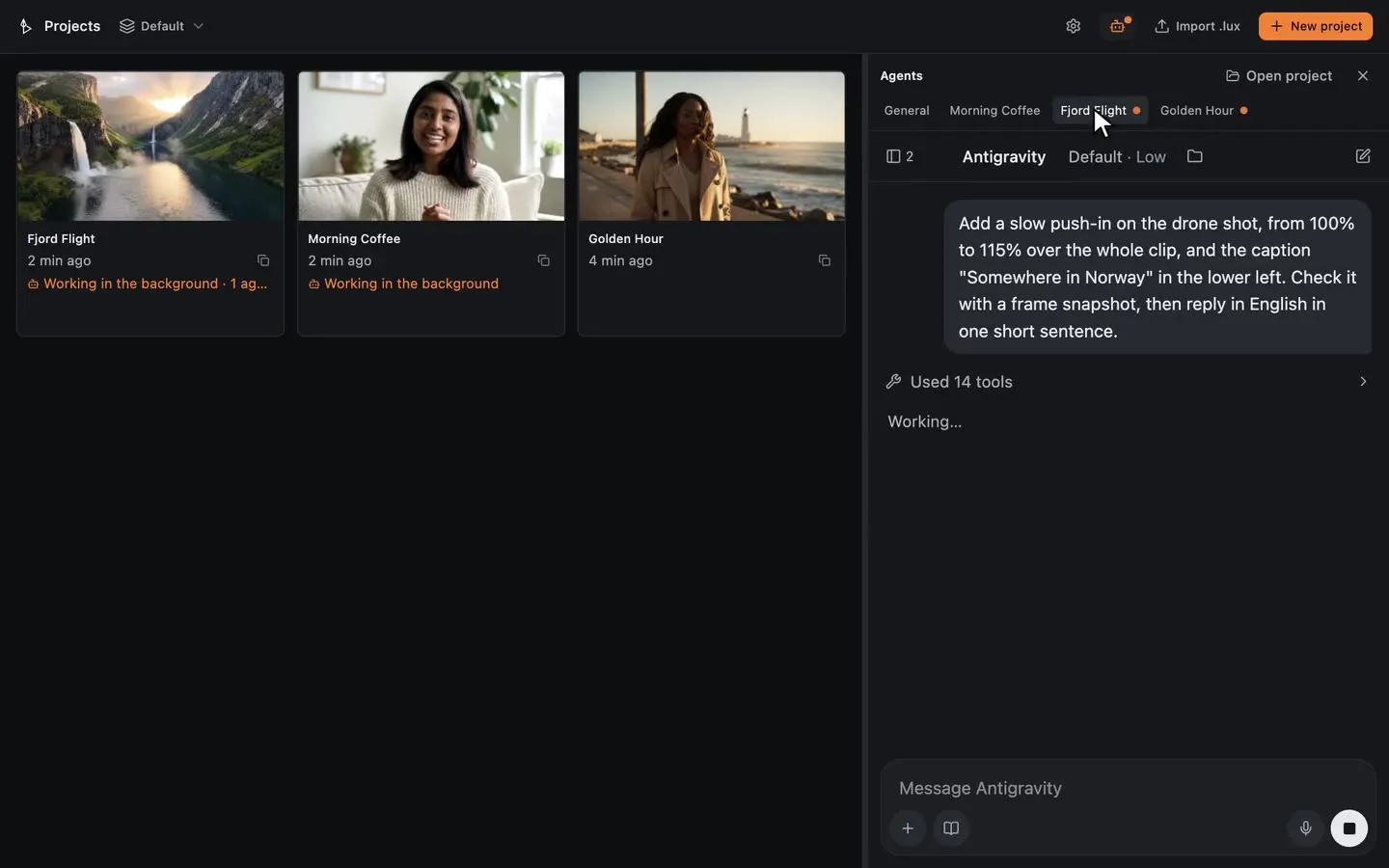
- The harness matters more every month. Beam ships with its own harness. Argon’s best demos are inside Antigravity. Muse Spark Open’s best demo is a model driving a real app. The value is moving to the layer where the model touches real tools.
- Video is next. Text and code got good first. Models that can follow motion, pick moments and act on a timeline are arriving now, and they’re arriving cheap.
Full disclosure, this is the bet behind what I’m building. Lugh Xtudio is a video editor where you bring your own agent and it edits on a real timeline you can still touch by hand. So yes, I’m biased. But I’d be writing this post either way.
What are you running these days, open, closed, or both? I’m genuinely curious.
Sources
- Meta, Introducing Muse Spark Open
- Hugging Face, Welcome Beam: a 501B open model you can own, customize, and scale and Reflection, Introducing Beam
- Mistral, Introducing Mistral Large 4
- Google, Gemini 4 Argon: Built to solve your hardest problems
- Anthropic, Introducing Claude Haiku 5.5
- Meta, Muse Wonder and pricing
- Elorian, Introducing Glimpse, and The Terminal, Elorian Glimpse: price, benchmarks and what is unverified